

How To Repair Cast Aluminum Without Welding
You don't take to be a professional person TIG welder to repair aluminum professionally.
You can actually use Aluminum braze to repair cracks, holes, leaks, rivets, broken ears, threads or fabricate aluminum, bandage aluminum, and cast fe apace, easily, and stronger than new.
It's not hard at all.
Many aluminum alloys can be brazed. Aluminum brazing alloys are used to provide an all-aluminum construction with excellent corrosion resistance and good strength and appearance.
The melting bespeak of the brazing filler metal is relatively close to that of the material existence joined. However, the base metal should not exist melted; as a result, close temperate control is necessary. The brazing temperature required for aluminum assemblies is adamant by the melting points of the base metallic and the brazing filler metallic.
Affix Aluminum Welding Nuts
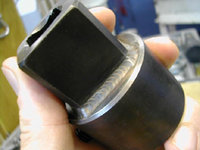
The process of brazing refers to the use of gas generated heat (800 degrees F), and an iron-free filler such as aluminum to bring together to unlike metals. The aluminum itself can too be used to supervene upon a part of some other metal that might have cracked or fallen off.
- Cost of Equipment: No argon gas, wire spool, gloves, shield, or electricity required.
- Portability: Stores easily, forth with pocket-size torch.
- Skills Needed: Unproblematic instructions almost anyone tin can apply. No flux, chemicals, or special cleaners required. 100% guaranteed.
- Danger: No high voltage electricity used.
- Oily Aluminum: Heli-arc boils aluminum and whatever impurities below the surface must be brought to the peak and cleaned off.
- Thin Aluminum: Melts 500 degrees earlier aluminum.
- Dissimilar Alloys: Works with whatsoever blend of aluminum or cast aluminum.
- Time Involved: Makes many repairs much quicker than conventional methods.
- Filling Holes: Instantly fills any size hole for threads much stronger than the original threads.
- Versatility: I product fills cracks or holes, rebuilds ears, seals leaks, or permanently bonds flat pieces.
Heat sources include a propane or MAPP gas, a turbo tip, or oxy-acetylene torch and special material.
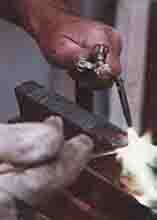
Advantages of brazing over welding
Many new and used parts that can be repaired with affix aluminum and be made stronger than the original form. Examples include:
- Aluminum heads
- Bandage iron heads
- A/C lines
- Timing covers manifolds
- Fuel tanks
- Wheels
- Aluminum Boats etc.
Brazing is a group of welding processes in which materials are joined past heating to a suitable temperature and past using a filler metal with a melting point above 840°F (449°C), but beneath that of the base of operations metal.
The filler metal is distributed to the closely fitted surfaces of the articulation past capillary action. The various brazing processes are described below.
Torch Brazing (TB)
Torch brazing is performed by heating the parts to be brazed with an oxyfuel gas torch or torches.
Depending upon the temperature and the amount of rut required, the fuel gas may exist burned with air, compressed air, or oxygen.
Brazing filler metal may be pre-placed at the joint or fed from handheld filler metal.
Cleaning and fluxing are sometimes necessary.

Aluminum Brazing Filler Metals
Commercial brazing filler metals for aluminum alloys are aluminum base. These filler metals are available as wire or shim stock.
A user-friendly method of preplacing filler metal is by using a brazing sail (an aluminum blend base of operations metal coated on one or both sides).
Heat treatable or core alloys composed mainly of manganese or magnesium are also used.
A tertiary method of applying brazing filler metal is to employ a paste mixture of flux and filler metallic pulverization. Mutual aluminum brazing metals contain silicon as the melting bespeak depressant with or without additions of zinc, copper, and magnesium.
Aluminum Brazing Flux
Aluminum affix flux is required in all aluminum brazing operations.
Aluminum brazing fluxes consist of various combinations of fluorides and chlorides and are supplied as a dry pulverisation.
For torch and furnace brazing, the flux is mixed with h2o to make paste. This paste is brushed, sprayed, dipped, or flowed onto the entire area of the joint and brazing filler metal.
Torch and furnace brazing fluxes are quite active, may severely attack thin aluminum, and must be used with intendance.
In dip brazing, the bath consists of molten flux. Less active fluxes can be used in this application and thin components tin be safely brazed.
Exercise Metal Brazing Techniques
Materials Needed:
- Automobile darkening welding helmet
- Carbon steel piping
- Brazing metal rod such as aluminum
Aluminum Affix Instructions:
- Kickoff by making sure that you lot have a safety environment to braze aluminum. This includes proper ventilation and a welding helmet.
- Adjacent, buy a small piece of carbon steel pipe.
- Place the pipage between ii fire bricks, laid about 3/4″ from each other
- Get your oxyacetylene torch and ready it to neutral
- Start on the side of the steel pipe that is nearly comfy for you (east.g; correct handed people starting time on the right side). Use the torch to melt off a piece of the filler rod onto the finish of the pipe.Note: After placing an initial corporeality of melted rod on the finish of the steel piping, employ the molten metal itself to melt more of the rod. Do not employ the torch flame. If you meet white fume ascension from the molten metallic, it means that y'all may become a poor weld
If you want to absurd the pipe and attempt again, pick upwardly with a tool and place in water a process called quenching a weld (water will weaken a weld, but for practise it is fine).
Here's a short 3 minute video:
Brazed Joint Blueprint
Brazed joints should be of lap, flange, lock seam, or tee type. Acquire more than about these joints here.
Butt or scarf joints are non generally recommended.
Tee joints let for first-class capillary flow and the germination of reinforcing fillets on both sides of the joint.
For maximum efficiency, lap joints should accept an overlap of at to the lowest degree twice the thickness of the thinnest articulation member. An overlap greater than ane/four in. (6.iv mm) may atomic number 82 to voids or flux inclusions. In this case, the apply of directly grooves or knurls in the direction of brazing filler metal flow is beneficial.
Closed assemblies should permit easy escape of gases and in dip brazing easy entry likewise every bit drainage of flux.
Good pattern for long laps requires that brazing filler metal flows in i direction but for maximum articulation soundness. The joint design must too permit complete post braze flux removal.
Brazing Fixtures
Whenever possible, parts should be designed to be self-jigging. When using fixtures, differential expansion tin can occur between the associates and the fixture to distort the parts.
Stainless steel or Inconel springs are often used with fixtures to accommodate differences in expansion. Fixture cloth tin can exist mild steel or stainless steel. However, for repetitive furnace brazing operations and for dip brazing to avoid flux bath contamination, fixtures of nickel, Inconel, or aluminum-coated steel are preferred.
Precleaning
Pre-cleaning is essential for the production of strong, leak-tight, brazed joints. Vapor or solvent cleaning will usually exist adequate for the non-rut treatable alloys. For heat-treatable alloys, still, chemical cleaning or manual cleaning with a wire brush or sandpaper is necessary to remove the thicker oxide film.
Furnace Brazing
Furnace brazing is performed in gas, oil, or electrically heated furnaces. Temperature regulation inside 5ºF (2.8ºC) is necessary to secure consequent results.
Continuous circulation of the furnace atmosphere is desirable since it reduces brazing time and results in more uniform heating. Products of combustion in the furnace can be detrimental to brazing and ultimate serviceability of brazed assemblies in the heat treatable alloys.
Aluminum Torch Brazing
Torch brazing differs from furnace brazing in that heat is localized.
Heat is applied to the part until the flux and brazing filler metal melt and wet the surfaces of the base metal.
The process resembles gas welding except that the brazing filler metal is more fluid and flows by capillary action.
Torch brazing is oft used for the attachment of fittings to previously weld or furnace brazed assemblies, joining of return bends, and similar applications.
Dip Brazing
In aluminum dip brazing operations, a large amount of molten flux is held in a ceramic pot at the dip brazing temperature.
Dip brazing pots are heated internally by direct resistance heating.
Low voltage, high current transformers supply alternating current to pure nickel, nickel alloy, or carbon electrodes immersed in the bath. Such pots are mostly lined with high alumina content burn brick and a refractory mortar.
WARNING
The acid solutions used to remove aluminum welding and brazing fluxes after welding or brazing are toxic and highly corrosive. Goggles, rubber gloves, and rubber aprons must exist worn when handling the acids and solutions. Practice non inhale fumes. When spilled on the torso or habiliment, wash immediately with big quantities of cold water. Seek medical attention.
Never pour water into acid when preparing solutions: instead, pour acid into water. Ever mix acid and water slowly. These operations should only be performed in well-ventilated areas.
Post brazing Cleaning
It is e'er necessary to clean the brazed assemblies, since brazing fluxes accelerate corrosion if left on the parts.
The most satisfactory manner of removing the major portion of the flux is to immerse the hot parts in humid water as soon as possible later on the brazing alloy has solidified.
The steam formed removes a major amount of residue flux. If baloney from quenching is a trouble, the function should be allowed to cool in air before being immersed in boiling water.
The remaining flux may be removed by a dip in concentrated nitric acid for five to xv minutes. The acid is removed with a water rinse, preferably in boiling water in club to accelerate drying.
An alternate cleaning method is to dip the parts for 5 to 10 minutes in a 10 percent nitric plus 0.25 percent hydrofluoric acid solution at room temperature. This treatment is as well followed by a hot water rinse.
For brazed assemblies consisting of sections thinner than 0.010 in. (0.254 mm), and parts where maximum resistance to corrosion is important. A mutual treatment is to immerse in hot water followed by a dip in a solution of 10 per centum nitric acid and ten pct sodium dichromate for 5 to 10 minutes. This is followed by a hot water rinse. When the parts emerge from the hot water rinse they are immediately dried by forced hot air to foreclose staining.
Other Aluminium Guides
Aluminum Soldering
Aluminum Gas Welding
TIG Welding Aluminum
Source: https://weldguru.com/aluminum-brazing/
0 Response to "How To Repair Cast Aluminum Without Welding"
Post a Comment